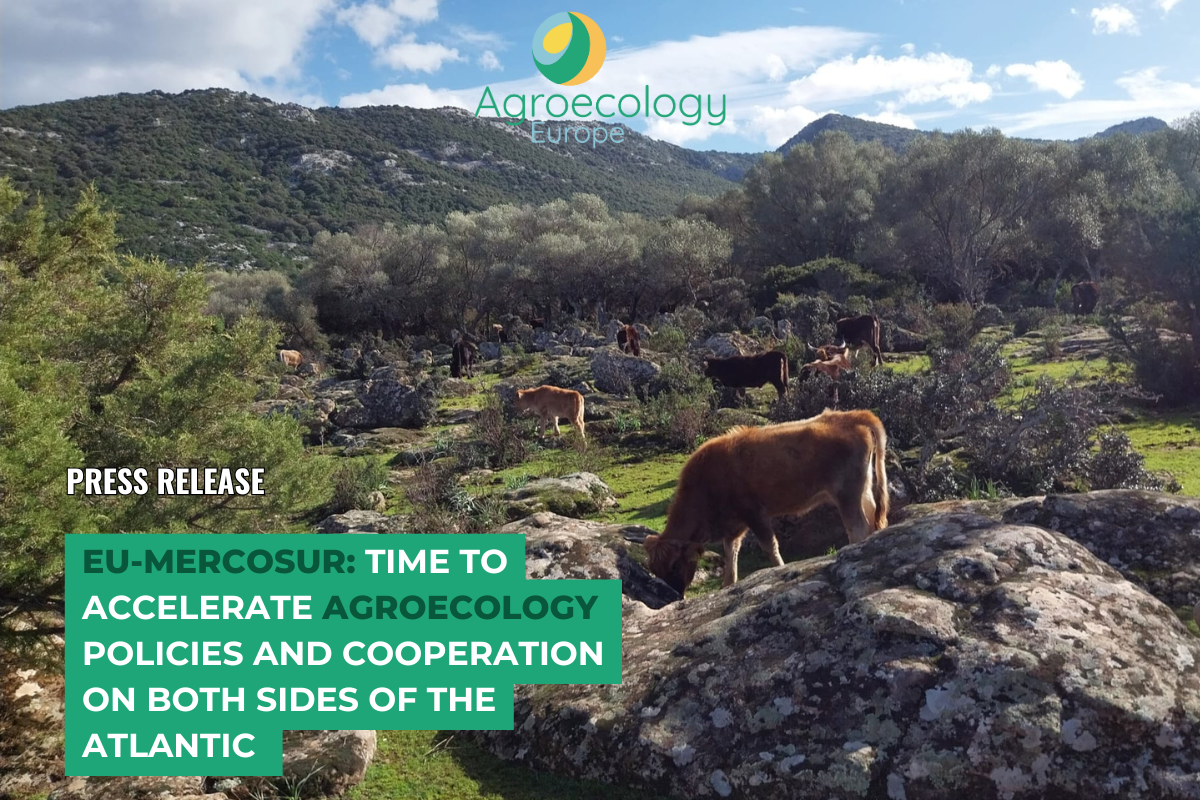
EU-Mercosur: a test case for whether agroecology can move from niche to policy
As the EU-Mercosur trade agreement advances despite farmer protests, Agroecology Europe argues both continents must accelerate agroecological policy — not as alternative, but as systemic governance strategy for food, climate, and rural resilience.
On 9 January 2026, the Council of the EU authorized signature of the EU-Mercosur Partnership Agreement and Interim Trade Agreement, advancing ratification despite widespread protests from farmers, peasants, and citizens on both sides of the Atlantic. The agreement still requires European Parliament consent — a juncture where elected members retain veto power. Studies from the Toulouse School of Economics and the Transnational Institute have documented expected harms to sustainable agriculture, environmental standards, and rural economies, with benefits accruing primarily to large commercial interests rather than small and medium-scale producers.
Agroecology Europe, a network spanning researchers, practitioners, and movements, issued a statement of solidarity with those who will bear the costs. But their response goes further: whether or not the agreement is ratified, they argue, both regions must urgently shift agroecology from niche alternative to core policy framework. This means treating it not as a marginal practice but as a governance architecture capable of integrating climate action, soil health, fair trade, public health, animal welfare, and rural resilience in a systemic way.
The press release frames agroecology as a form of “strategic direction” — language that signals a move from pilots and experiments to institutional infrastructure. It’s a reminder that governance isn’t only what happens in Brussels or Brasília, but also in the design of food systems, land use, and the relationships that structure rural economies. The question is whether such systems can be redesigned while trade agreements pull in the opposite direction — or whether the friction itself becomes a forcing function for deeper change.