Five Years of Agroforestry Practice in Costa Rica: Jungle Project's Farmer-First Model
Over 20 hectares and 18,000 plants later, Jungle Project demonstrates how governance begins with land stewardship — training 22 farmers in regenerative agroforestry while building the market infrastructure to sustain it.
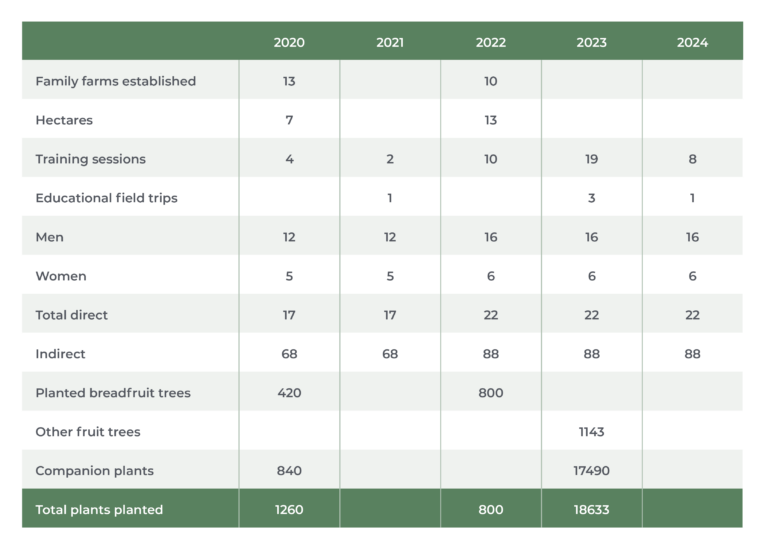
Governance doesn’t only happen in assemblies or policy documents — it also unfolds in the deliberate work of establishing regenerative systems on the ground. Over five years, Jungle Project has built a farmer-first agroforestry model across Costa Rica’s Caribbean coast and volcanic slopes, establishing 22 breadfruit farms integrated with companion crops like citrus, cacao, and avocado. More than 18,000 plants now grow across 20 hectares, supported by 43 training sessions and field trips to institutions including EARTH University and Costa Rica’s National Institute of Apprenticeship.
The project operates as both ecological intervention and economic redesign. Through Jungle Foods, the team has created a values-aligned supply chain — breadfruit flours, noodles, specialty cacao — that prioritizes small-scale farms over extraction. In 2025, they received non-reimbursable capital from CATIE’s business incubation initiative, recognition of a model that treats market development as inseparable from land stewardship.
What makes this work significant isn’t scale alone, but the integration: farmers trained as technicians, agroforestry as food security infrastructure, commercial products as proof that regenerative systems can sustain themselves. Kiss the Ground’s five-year fiscal sponsorship provided the administrative backbone for this experimentation — a form of solidarity that let soil advocates focus on practice rather than paperwork.
The data table tells part of the story: steady growth in participants, dramatic scaling in companion plants from 840 to 17,490 between 2020 and 2023. But the fuller narrative is about what happens when education becomes implementation, and implementation becomes a repeatable model. Governance, here, means creating the conditions for stewardship to endure.