What makes a rewilding image worth seeing — and judging
As the Rewilding Europe Award deadline approaches, photographer Jon A. Juárez reflects on what makes rewilding imagery matter: not just aesthetics, but the governance relationships between people, science, and returning ecosystems.
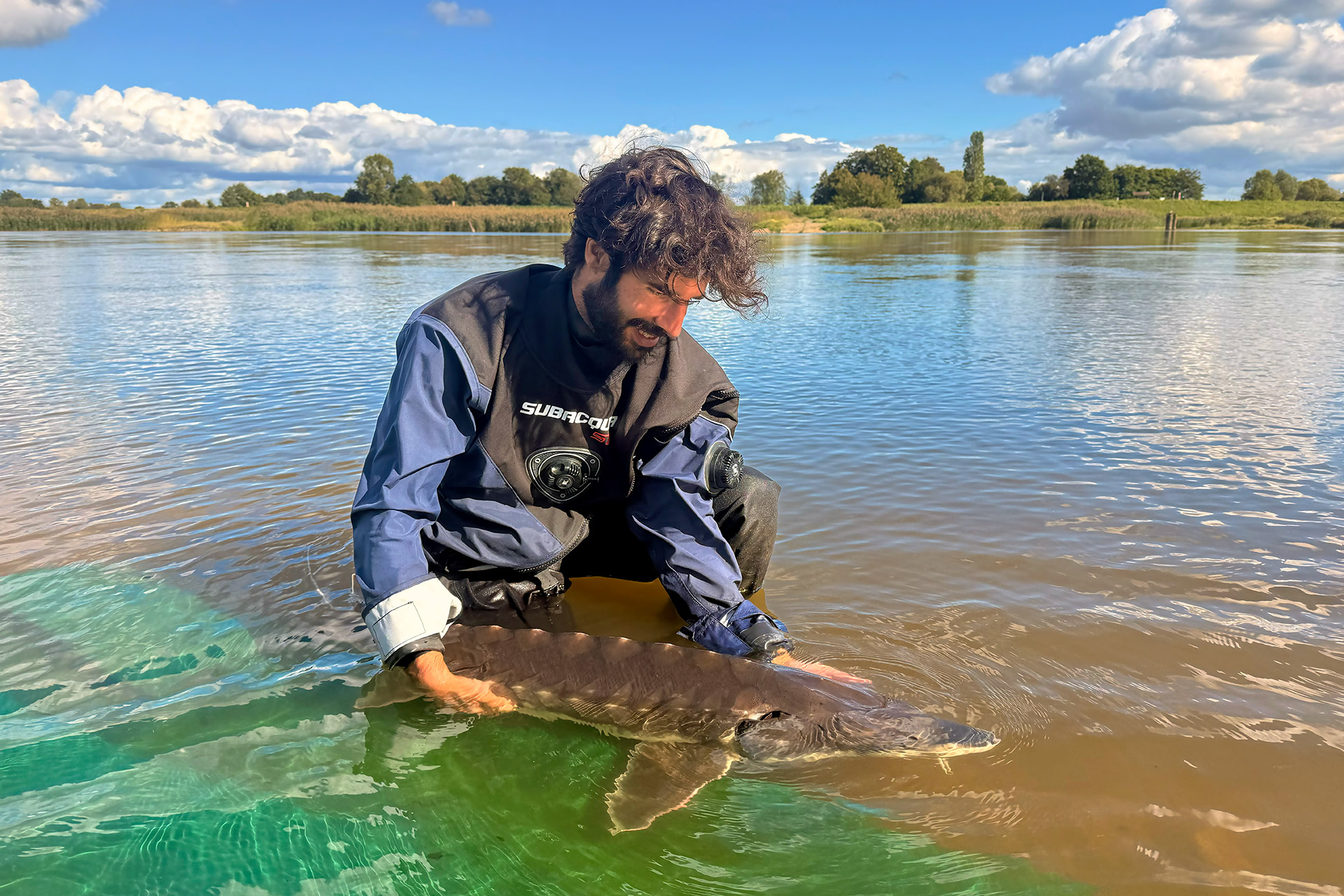
Jon A. Juárez won last year’s Rewilding Europe Award with an image of an Atlantic sturgeon being released into Sweden’s Göta River — a single frame that distilled days of coordinated transport, tagging, acclimatisation, and scientific commitment. Now serving as a judge for this year’s award, the Berlin-based photographer and biologist emphasizes that rewilding photography should capture more than charismatic wildlife. It should reveal the relationships that make restoration possible: the scientists building release cages, the communities negotiating coexistence, the governance structures that allow long-extinct species to return.
Juárez’s work spans underwater, aerial, and terrestrial perspectives — an adaptability he once saw as a weakness in a field dominated by specialists. He’s come to understand it as essential to his practice: different angles reveal different layers of the story, and conservation narratives require responsiveness to what the moment demands. His ongoing collaboration with the Leibniz Institute for Zoo and Wildlife Research has shown him that compelling imagery doesn’t just translate science for public audiences — it functions as infrastructure within research itself, strengthening grant applications and policy discussions.
What he looks for in this year’s submissions isn’t technical innovation but evidence of dedication: images that show rewilding as a practice of reconnection, not just species return. “Rewilding is as much about people reconnecting with landscapes as it is about wildlife returning,” he notes. The best images, in his view, capture coexistence, resilience, and real impact — the governance performance of restoration work, visible in a single exposure. The deadline for submissions is 1 March.
This is governance at ecological scale: not policy documents but the coordinated effort to build a cage in a river, time a release with scientific precision, and document the moment when commitment becomes return. Photography here functions as both witness and infrastructure — making the invisible labor of restoration legible, and the abstract promise of recovery concrete.