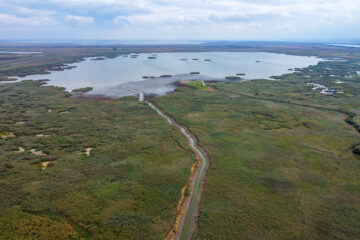
Lake Kartal: wetland governance tested at war's edge
In Ukraine's Danube Delta, six years of restoration has reconnected 18,000 hectares of floodplain to the river — a reminder that ecological governance means reshaping flows, not just protecting boundaries, even under the strain of invasion.
In the Ukrainian part of the Danube Delta, the Rewilding Ukraine team has spent six years removing dams, clearing channels, and installing sluice pipes to reconnect Lake Kartal with the Danube. The result: 18,000 hectares of wetland now exchange water freely with the river, reversing decades of drainage infrastructure that choked off the floodplain. The final phase — reopening five kilometers of the Luzarza channel — has increased water flow by 40%, bringing the system closer to its natural hydrology and revitalizing 450 hectares of habitat.
This is wetland governance as physical practice: not policy documents but excavators and water levels, tested against the comeback of fish stocks and nesting birds. “When ecosystems here receive enough water — and when that water is clean — nature has an extraordinary ability to heal itself,” notes Oleg Dyakov, rewilding officer with the project. Panas Zhechkov of the Izmail Department of Water Resources, a long-term collaborator, points to tangible returns: rising water quality, richer fish populations, renewed irrigation capacity for farmers.
The work has proceeded through Russia’s invasion — a governance stress test of another kind. Where war has disrupted livelihoods and stalled nature-based tourism, Lake Kartal offers a counter-narrative: healthier wetlands as infrastructure for post-conflict recovery, supporting fishermen and building resilience while the larger question of Ukraine’s future remains unresolved. Wetlands cover 6% of Earth’s land surface but support 40% of terrestrial species — Europe has lost half of them in three centuries. Lake Kartal’s rapid recovery suggests that restoration, when grounded in hydrological realities rather than preservation rhetoric, can move faster than we expect.