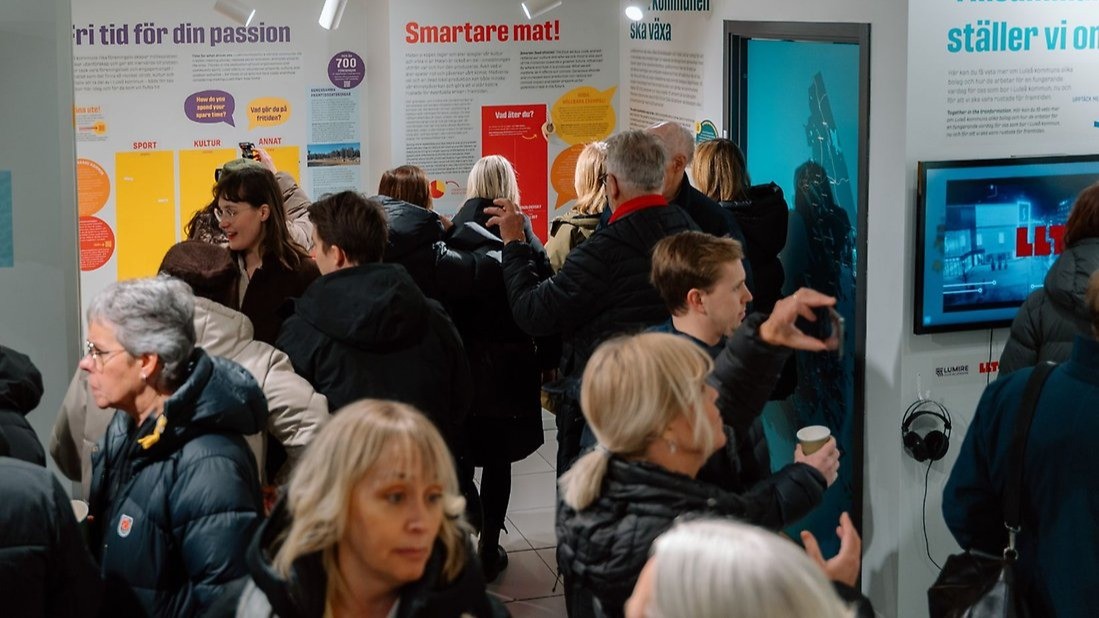
Luleå's transition exhibition: governance as public pedagogy
A Swedish industrial city places climate transition in a shopping mall — treating governance not as policy abstraction but as something residents encounter while buying groceries. The experiment tests whether municipal legitimacy can be built through visibility.
Luleå, a northern Swedish city of 78,000 navigating rapid industrial decarbonization, has opened “The Luleå Way” — a climate transition exhibition in a shopping center. The placement is deliberate: municipal officials and industrial actors explain steel plant conversions, circular construction pilots, and renewable energy timelines where people already gather, no appointment needed. It’s governance as storefront, a bet that legitimacy comes from accessibility rather than consultation theater.
The exhibition supports a broader mobilization architecture. Luleå convened a citizens’ forum in 2025 — randomly selected residents working with experts from the steel industry, university researchers, and municipal staff across four full-day sessions. Recommendations now feed into a climate plan targeting municipal carbon neutrality by 2030, territorial neutrality by 2040, and resident-scale action by 2045. The targets are scaffolded by organizational capacity, a recognition that governance operates at different speeds across institutional boundaries.
Meanwhile, five northern Swedish cities have formed Thriving Northern Cities, pooling resources on circular building standards and transit electrification — the kind of horizontal coordination that emerges when national frameworks move too slowly. Process leader Sophie Forsberg describes a meal program redesign that cut food waste while keeping portions at 12 kronor, proof that climate action and fiscal constraint can align when implementation involves the people doing the work. Whether a shopping mall can host the messy work of transition remains an open question, but Luleå is testing the premise that governance must be encountered, not merely announced.