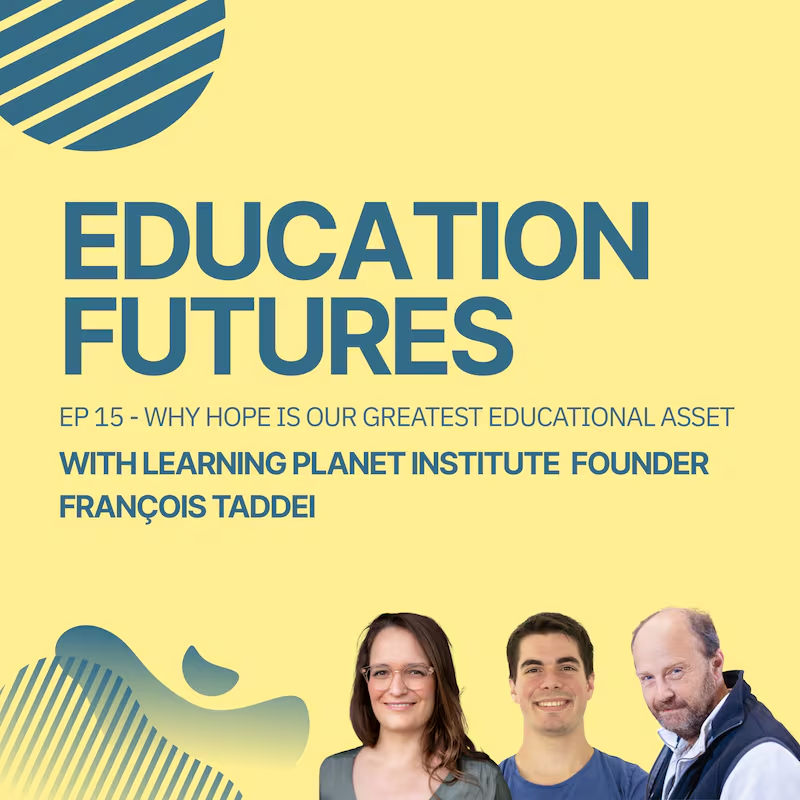
Hope as Educational Infrastructure
François Taddei frames hope not as sentiment but as educational architecture — a necessary foundation for governance systems that must adapt to planetary-scale challenges while remaining rooted in human capacity for learning.
The Learning Planet Institute’s latest podcast episode features co-founder François Taddei making a deceptively simple claim: hope is education’s greatest asset. But this isn’t motivational rhetoric — Taddei is arguing for hope as infrastructure, as the substrate that allows learning systems to function under conditions of radical uncertainty.
The timing matters. As governance systems face challenges that exceed the capacity of existing institutional knowledge — climate adaptation, technological disruption, ecological collapse — the ability to maintain orientation while learning becomes itself a form of institutional design. Taddei’s framing suggests that educational systems, like governance systems, must be built to sustain inquiry even when answers remain distant.
This connects to a broader recognition emerging across democratic innovation work: that the emotional and psychological dimensions of institutional life aren’t peripheral concerns but foundational ones. Systems that can’t sustain hope — understood here as the capacity to continue learning and adapting — become brittle exactly when flexibility matters most. The question isn’t whether to feel hopeful, but how to build structures that make sustained engagement possible.